University of Arizona Students Develop Therapeutic Garden Plan for Watermark Community
June 24, 2026
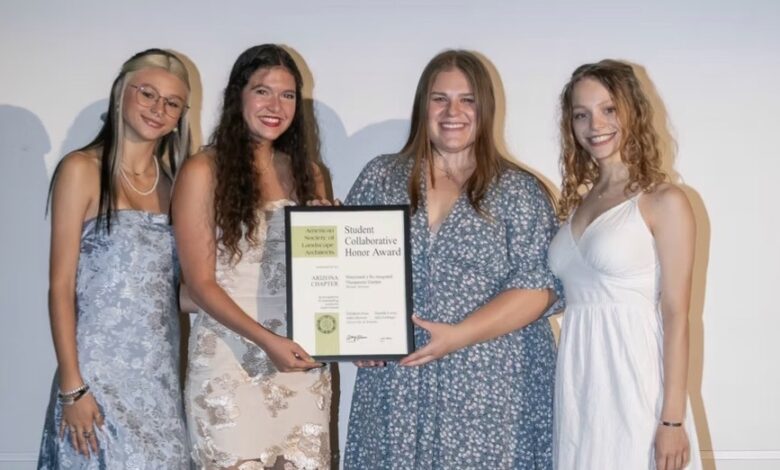
Caption: From left, Jaden Barnum, Elizabeth Allen, Julia Esslinger and Danielle Covey accept an award from the Arizona Chapter of the American Society of Landscape Architects for a garden design at The Hacienda at the River.
University of Arizona Students Develop Therapeutic Garden Plan for Watermark Community
TUCSON, Ariz. — A team of University of Arizona architecture students has developed plans for a therapeutic memory care garden at The Hacienda at the River, a Watermark Retirement Communities-managed community in Tucson.
The student team’s plans recently received a General Design Honor Award from the Arizona chapter of the American Society of Landscape Architects. The design includes looped pathways intended to support exploration without confusion, garden beds shaped to accommodate wheelchairs and nontoxic plants selected to stimulate the senses.
The project is the latest collaboration between Watermark Retirement Communities and the University of Arizona. Stan Barter, director of architectural design for Watermark, said the work could inform outdoor environments at other Watermark communities.
“My aim is to use the research and design work generated through this partnership to inform a future national standard for experiential healing landscapes across Watermark communities,” Barter said. “Our work together is creating a new model for outdoor environments centered on dignity, wellness, autonomy and beauty.”
The four-person student team included Bachelor of Landscape Architecture seniors Elizabeth Allen, Jaden Barnum, Danielle Covey and Julia Esslinger. Over the course of a semester, the students studied how outdoor environments can support people living with Alzheimer’s disease and other forms of dementia through movement, circadian rhythms, sensory stimulation, seasonal change, social connection and emotional regulation.
The students reviewed existing research and consulted with Watermark leaders, residents and faculty advisers from the university’s College of Architecture, Planning and Landscape Architecture and the Andrew Weil Center for Integrative Medicine.
According to the news release, residents asked the students not to remove elements from the existing outdoor space. The final plans instead focus on adding to the garden and improving organization and functionality. The design incorporates existing statues as familiar markers and calls for more shade, outdoor exercise areas and native vegetation.
Richard Benner, executive director of The Hacienda at the River, said the students’ plans reflect resident feedback as well as requests from community leadership. Increased shade was a priority, he said, because some unshaded areas are difficult to use for much of the year.
“With increased shade, we can move some of our exercises, such as Tai chi, back outside and enjoy doing them in nature, even on warmer days,” Benner said.
Benner said other design elements, including grassy areas, are intended to create tactile experiences for residents.
“I imagine the members of our community kicking off their shoes and feeling the grass beneath their feet,” he said. “This is especially important for our Memory Care residents, who take comfort in experiences that transport them back in time to enjoy fond memories, such as playing in a grassy park as a child.”
Allen said the student team focused on incorporating sensory elements throughout the garden.
“Our group was especially committed to incorporating all five senses into the therapeutic garden experience, and we worked thoughtfully to reflect those elements throughout the proposed design,” she said.
Watermark plans to move forward with the design, with construction expected to be completed in 2027, according to the release.
Bo Yang, associate dean for research and professor of landscape architecture and urban planning at the university’s College of Architecture, Planning and Landscape Architecture, served as a co-adviser for the project and liaison between the university and Watermark. He said public health faculty members expect to study the completed garden.
“We will be able to track and observe how this thoughtfully designed outdoor space affects people and contributes to healthy aging,” Yang said. “We want to work together to develop this as a standard use case for other Watermark Retirement Communities.”
The interdisciplinary faculty adviser team also included Kenneth Kokroko, Shujuan Li, Sandra Bernal and Altaf Engineer.
Watermark Retirement Communities manages senior living communities across the United States. The company has more than 35 years of senior living experience.
***
Do you have business news to share on Senior Living News? Contact us here.
Do you have business news to share on Senior Living News? Contact us here.